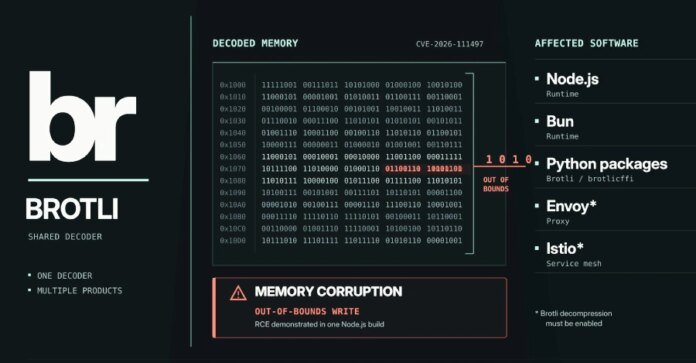
Critical Memory-Corruption Flaw Exposes Multiple Software Applications in Push Against Brotli Compression
What Happened
A critical memory-corruption vulnerability affecting the Brotli decoder has been identified, officially tracked as CVE-2026-111497. This flaw resides in numerous applications that utilize the Brotli compression standard, including but not limited to, packages like Bun, Python’s Brotli, and brotlicffi, as well as Envoy proxies configured for decompression tasks. By exploiting this vulnerability, attackers can craft specially designed compressed data, corrupting memory beyond buffer limits and possibly compromising program stability and security. The flaw was discovered through standard vulnerability assessments but disclosed to the public only after active probing indicated its potential exploitation in the wild. Given the broad usage of Brotli in web applications and data transmission, the potential scale of affected applications is extensive, raising significant alarm about the ease of exploitation and its repercussions.
Why This Breach Matters
This incident underscores an alarming trend in the exploitation of widely trusted and deployed compression libraries. Memory-corruption vulnerabilities are particularly severe because they can lead to unauthorized access and control over affected systems. What makes CVE-2026-111497 noteworthy is not just its technical specifics but its commonality across various software applications that are foundational in many web services today. The incident reflects a larger pattern where established libraries, often taken for granted, become vectors for attack due to latent vulnerabilities. Compared to other recent breaches involving memory corruption, this vulnerability emphasizes the danger of unchecked open-source dependencies, which, while beneficial for fast-paced development, can introduce hidden risks that evade traditional security measures.
The Attack Chain: How It Likely Unfolded
The attack process likely began with reconnaissance, wherein threat actors identified software utilizing the Brotli decoder. Once this was established, they would craft malicious Brotli-compressed data designed to manipulate memory buffers. This initial access vector could be delivered through various channels, such as phishing emails or harmful dependencies that may be inadvertently included in project builds. As the attack unfolds, the corrupted buffer could enable lateral movement within the software environment, potentially granting the attacker access to sensitive configurations or data. While the exact dwell time remains unspecified, the prevalence of pressure on developers to adopt newer libraries frequently can often lead to exposure, delaying patching cycles and exacerbating vulnerabilities in production environments.
Who Is Most at Risk
Organizations relying heavily on web services that utilize Brotli compression are particularly vulnerable. Many sectors—technology, e-commerce, and media—frequently leverage Brotli for performance optimization in data transmission. Enterprises of all sizes utilizing platforms or applications built with Bun, Python’s Brotli packages, or Envoy proxies are notably at risk, especially those deploying these technologies without robust memory safety checks. The data at risk spans a wide array of user interaction and transactional data, where compromised program execution could lead to unauthorized access or integrity issues affecting customer trust and business operations.
Defensive Actions and Recommendations
In response to CVE-2026-111497, security teams must prioritize immediate actions and long-term strategies:
Immediate Actions (24–72 hours):
- Conduct a software inventory to identify all applications using Brotli decoders.
- Assess and apply any available patches or mitigations released by maintainers of affected libraries. Immediate patching of software installations, especially the affected packages, should be prioritized.
- Implement web application firewalls (WAFs) configured to monitor and filter out anomalous Brotli-encoded traffic.
Short-term Strategic Recommendations (1–3 months):
- Develop a routine monitoring framework for identifying updates and vulnerabilities in third-party libraries, leveraging tools like Snyk or Dependabot for continuous dependency scanning.
- Conduct regular security training for development teams to reinforce secure coding practices and raise awareness of current vulnerabilities impacting their dependencies.
- Long-term Strategic Recommendations:
- Establish a security baseline driven by frameworks such as NIST or CIS Controls, focusing on secure coding standards and memory safety. This should include conducting static and dynamic application security testing (SAST/DAST) as part of the software development life cycle (SDLC) to discover vulnerabilities sooner.
- Engage third-party security assessments or penetration testing to identify memory-related vulnerabilities beyond routine scans, ensuring a holistic analysis of potential weak points in their systems.
Regulatory and Legal Exposure
The breach implications extend into regulatory realms, particularly for organizations operating in sectors governed by GDPR, PCI-DSS, or HIPAA. Any compromise of user data through software utilizing the flawed Brotli decoder may trigger notification obligations according to local laws and industry standards. Additionally, organizations must consider the liabilities associated with failing to maintain secure software practices, which could invite regulatory scrutiny or legal action from affected parties.
Full Circle Cyber Analyst Takeaway
The lesson from this vulnerability is clear: organizations must adopt more rigorous dependency management and software security protocols. Reliance on open-source libraries without a thorough understanding of their security implications exposes enterprises to consequential threats. It is imperative that practitioners strengthen their focus on secure coding practices and perform timely updates to inventory libraries. As threats like CVE-2026-111497 emerge, vigilance is the best defense.

