Exploitation of Placeholder Domains: A New Vector for Malicious Cloudflare Spoofing Attacks
Attack Summary
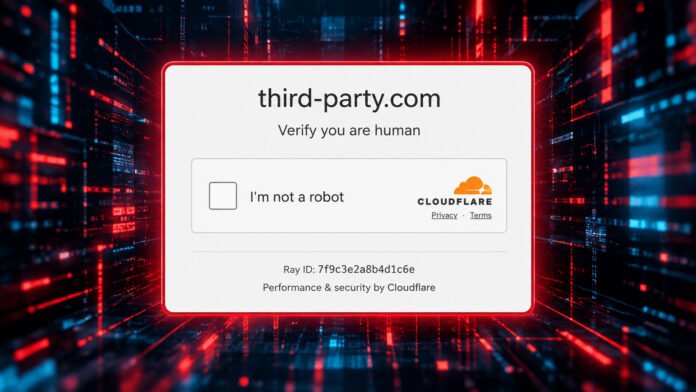
Recent investigations into a fraudulent campaign utilizing the domain "third-party.com" reveal a sophisticated attempt to compromise Windows users through a fabricated Cloudflare verification page. This attack, attributed to unknown actors, capitalizes on the widespread use of "third-party.com" as a placeholder in code documentation, making it an ideal vehicle for social engineering. The attackers aim to leverage this domain to deceive users into executing malicious PowerShell commands on their systems, indicating a focus on espionage or data exfiltration. No evidence directly linking this campaign to specific nation-state actors has been reported, but the methodical use of a trusted service’s brand for malicious intent demonstrates a high degree of planning and sophistication. Compromised users may suffer from unauthorized access to sensitive data or system integrity breaches, potentially leading to broader infrastructural impacts.
Tactics, Techniques, and Procedures (TTPs)
The attack methodology closely follows adversarial patterns documented in the MITRE ATT&CK framework. Initial access is likely achieved through social engineering techniques such as phishing (T1566), wherein users are lured to a counterfeit Cloudflare page. The use of a known placeholder domain provides a veneer of legitimacy, facilitating exploitation. Once access is gained, persistence appears to hinge on executing malicious PowerShell scripts (T1059.001) that may create persistence mechanisms or download additional payloads.
Following initial execution, the command-and-control (C2) infrastructure relies on the control of the fake web page itself, which may leverage standard HTTP/S requests to mask its activity with legitimate traffic. Lateral movement could involve further PowerShell exploitation or credentials harvested from the compromised systems (T1078 – Valid Accounts); however, precise techniques used for lateral movement remain unreported. For exfiltration, actors may use command-line interfaces or embedded scripts to transfer sensitive data to external servers (T1041 – Exfiltration Over Command and Control Channel).
Threat Actor Context
While attribution remains elusive, the sophistication exhibited in the attack suggests a well-resourced threat group likely motivated by espionage or financially driven objectives. Historical patterns indicate that similar techniques have been employed by threat actors with ties to geopolitical interests, particularly those seeking to undermine trust in widely used third-party services or gain unauthorized access to corporate environments. The choice of a domain popular in developer communities suggests a targeting strategy aimed at software development firms or organizations utilizing cloud infrastructure reliant on services like Cloudflare. Previous campaigns utilizing domain spoofing indicate actors with advanced social engineering skills and familiarity with software development processes.
Indicators of Compromise (IOCs)
The campaign’s use of "third-party.com" as a deceptive vector raises concerns regarding the wide range of compromised entities utilizing similar placeholder domains. As of now, no specific IP addresses or file hashes have been disclosed, however, organizations must be vigilant. Potential IOCs to monitor include variations of the domain itself, suspicious PowerShell execution from endpoints, and outbound HTTP/S traffic that resembles known C2 patterns. Security teams should also keep an eye out for communication with any URLs that deviate from established organizational practices, which could signal an initial compromise event.
Detection and Hunting Guidance
To detect such spoofing attempts effectively, organizations should implement a multifaceted approach. Firstly, deploy EDR solutions capable of identifying anomalous PowerShell executions, including atypical command line arguments (e.g., PowerShell scripts attempting to download or execute from untrusted sources). SIEM queries should be designed to flag interactions with the "third-party.com" domain and any suspicious redirect activity. Additionally, routine reviews of network traffic logs may reveal unusual patterns, particularly those involving outbound communications with HTTP/S requests that are not part of the organization’s known service set.
Leveraging threat intelligence feeds to correlate network activity with published IOCs can enhance detection efficacy. Continuous user awareness training should also focus on identifying signs of social engineering attempts and the potential risks associated with executing code from unverified sources.
Mitigation Recommendations
To mitigate the risk of these types of attacks, organizations should prioritize the following controls:
- Enforce strict application whitelisting policies to limit PowerShell executions to pre-approved scripts.
- Implement network segmentation to contain potential breaches and limit lateral movement capabilities.
- Utilize endpoint protection systems that actively monitor for and block PowerShell activity that deviates from established organizational workflows.
- Conduct vulnerability assessments to strengthen existing defenses against social engineering tactics.
- Implement user training programs focused on recognizing phishing attempts and brand impersonation tactics, specifically emphasizing the importance of verifying website URLs.
Full Circle Cyber Analyst Takeaway
This incident underscores the escalating sophistication of threat actors leveraging common developer tools and familiar services to exploit unsuspecting users. Organizations must remain vigilant against domain spoofing and look to reinforce their defenses through user education and advanced security measures. As these tactics continue to evolve, understanding the nuances of social engineering and attack vectors will be vital in operational resilience efforts moving forward.

